Inwood Animal Clinic Blogs

Halloween Safety: Tryon’s Guide to Surviving the Spookiest Night of the Year
Hello, friends. Tryon here. If we haven’t met, I’m the small, loud, exceptionally fluffy member of the Inwood Animal Clinic team. And while my official job description is somewhat unclear, I consider myself highly qualified in several areas, including supervising the local pigeon population, looking adorable, and investigating anything that smells remotely edible.
Which brings me to Halloween.
Humans seem to love Halloween. They decorate with skeletons, willingly allow strangers to repeatedly ring that obnoxious doorbell, dress their two-legged children in bizarre outfits, and buy big bags of candy that they refuse to share.
Frankly, the entire holiday is highly suspicious. And for pets, it can actually be a little dangerous. So, come along with me as I walk you through a typical Halloween night from my perspective and show you how to keep your furry family members safe.
5:00 p.m.: The candy arrives
There it is. The special bowl that only comes out once a year. It’s sitting on the counter, filled to the top with colorful little packages that smell very interesting. Any dog worth his snout would approach for further investigation, of course—only to be met, no doubt, with a swift, “Aht, no!” Rude, I know.
Unfortunately, you humans are right. Halloween candy is meant for trick-or-treaters, not pets. Chocolate can be toxic to dogs and cats, with darker chocolate generally containing higher concentrations of the poisonous compounds. Sugar-free candy and gum can contain xylitol, a sweetener that is extremely dangerous for dogs. Raisins are also dangerous.
Even candy that isn’t inherently toxic can cause problems when pets eat too much of it—or decide the wrapper looks delicious, too. Candy wrappers, lollipop sticks, and treat bags can become choking hazards or cause an intestinal obstruction.
My professional recommendation: Keep the candy bowl somewhere paws and curious noses cannot reach. I can’t guarantee we won’t continue to monitor it from below.
5:45 p.m.: Someone produces a pet costume
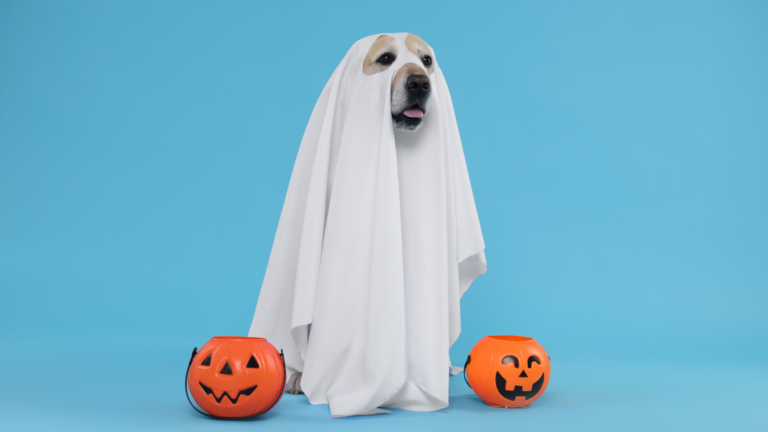
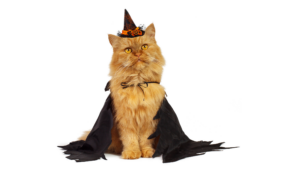
Some pets genuinely enjoy dressing up. Others would rather spend Halloween completely naked, thank you very much. If your pet will be wearing a costume, make sure it fits comfortably and doesn’t restrict their breathing, movement, hearing, or vision. Check for small pieces they could chew off and swallow, and never leave a costumed pet unattended.
Watch your pet’s body language, too. Freezing in place, hiding, struggling to escape, flattened ears, tucked tails, excessive panting, or other unusual behavior can mean your pet isn’t enjoying the festivities as much as you want them to.
If they’re miserable, let them skip the costume. They’re already adorable enough—trust me, I’m an expert.
6:03 p.m.: DING-DONG.
INTRUDER.
Naturally, the mighty protector of the house will sprint toward the door. The humans claim it’s just a “trick-or-treater.” I remain unconvinced.
Halloween can be overwhelming for pets who are sensitive to strangers, costumes, loud noises, or—like me—the incessant invasion of their home every five minutes.
The safest option may be to restrict your pet to a quiet room away from the front door with their bed, toys, water, and a relaxing distraction, like a snuffle mat or a filled, frozen Kong. You can also turn on a television, fan, or music to help soften the shrieks and spooky music coming from the neighbor’s animated display. Be especially careful when opening the door; even pets who normally stay close can slip outside when they’re frightened or excited.
Before Halloween night begins, double-check that your pet is wearing identification and that their microchip information is up to date. If I ever accidentally escape while pursuing a suspicious miniature witch, I would very much like to be returned home once I catch them.
 7:12 p.m.: I almost set the house on fire
Naturally, one needs to put their face near a glowing pumpkin. This is apparently yet another bad idea. Who knew?
Jack-o’-lanterns with real candles can burn curious noses, whiskers, paws, or tails and may be knocked over by excited pets. Battery-operated candles are a much safer way to achieve your spooky ambiance, but I still wouldn’t leave them unsupervised in case they start to look like a glowing treat.
Keep electrical cords, string lights, fake spiderwebs, glow sticks, and small decorations away from pets, too. Cats are particularly talented at turning any dangling decorations into a toy, while dogs like me occasionally investigate things with our mouths. I call it research, but apparently the team at Inwood Animal Clinic calls it a “potential foreign body.”
9:30 p.m.: The tiny monsters have finally stopped arriving
The streets are quiet of little children. The candy bowl is significantly emptier. That silly costume has mysteriously disappeared. And we have survived another Halloween. The biggest thing humans should remember is that Halloween should be fun for us, too—and sometimes our idea of fun is different from yours. Whether your dog wants to greet every trick-or-treater or celebrate Halloween with a favorite chew and no responsibilities, let them choose their own adventure. If your cat would prefer to spend the evening under the bed rather than dressed as a pumpkin, that’s OK.
Know your pet, plan ahead, and keep hazards safely out of reach. If you have questions about keeping your pet safe this spooky season, or they’re due for a checkup, the Inwood Animal Clinic team is here to help. As for me? I’ll be recovering from a long evening of protecting everyone from ghosts, goblins, doorbells, and that extremely dangerous bowl of miniature candy bars. It’s a very important job, and not many are as dedicated to the task as I am.
Happy Halloween!
—Tryon